A safe space

The advice is clear: STAY AT HOME and prevent deaths. Now that we are confined to our homes for all but essential reasons, any of us with a green space of our own should be feeling extremely blessed right now. I know I am.

stay at home
The advice is clear – stay at home!

Our gardens offer safe full-time access to fresh air and sunshine, and provide us with a purpose. Most importantly, in this time of heightened anxiety and uncertainty, they are a crucial means of maintaining our mental wellbeing.

Haven from Covid-19
I can think of worse places to be in a lockdown

Working from home

I am working full time from home at a desk-based job, so my time in the garden remains limited to 15-minute bursts of activity. Given the ever-stricter curbs on daily life that we are now getting our heads around, those 15 minutes spent outside, working with plants and reconnecting with nature, seem even more precious.

Physical and mental benefits

The benefits of gardening are well documented and numerous.

  • Provides regular easy access to fresh air and sunshine.
  • Provides an opportunity for ‘moderate’ physical activity – why not burn a few extra calories.
  • Helps to maintain heart, muscle and bone health.
  • Relieves stress.
  • Improves mood.
Garden for your physical and mental health
There is no place I’d rather be right now

In these scary times, our gardens offer a safe place away from Government press conferences, social media memes and toilet roll hunts … as well as from Covid-19 itself. So if you are feeling anxious, stressed, helpless, confused or angry (I’ve certainly experienced all of those emotions in the last 7 days), turn to your garden. It’s waiting for you.

Stay home, stay safe, stay positive!

A tidy shed

I’m not a naturally tidy person (understatement) and last year the shed became a dumping ground for, well, for everything.

My potting bench had disappeared under a jumbled pile of (dirty) plastic pots and trays and the floor was an assault course of half-used compost bags, discarded horticultural fleece, terracotta pots stored out of the frost and a depressing carpet of mud clods and matted grass.

An untidy shed
Last year’s clutter – and this picture was taken half an hour after I started tidying!

The clutter and chaos was putting me off starting my sowing, so this weekend I couldn’t ignore it any longer. First, I organised the plastic pots by size and stowed them away in trays under the bench. I then cleared a winter’s worth of cobwebs from the windows.

After consolidating the random bags of compost and potting grit and neatly hanging my tools on the many hooks on the walls (courtesy of my organised husband!), I brushed the debris from the potting bench and swept the floor.

I revealed a space that I’m now looking forward to working in and in which I’ll be able to find what I need when I need it (I even found a bag of seed compost that I didn’t know I had!).

Tidy potting bench
Everything back in its rightful place

I’m resolved to keep it tidy this year. But then, I think I said that last year too. I promise I’ll try !!

Pruning Buddleja davidii

In stark contrast to my husband, who will happily take a hedge cutter to anything, I’m a bit of a wuss when it comes to pruning. I’m still a bit cautious with the secateurs on most shrubs, but there’s one plant that I know I can be brutal with: Buddleja davidii (the butterfly bush).

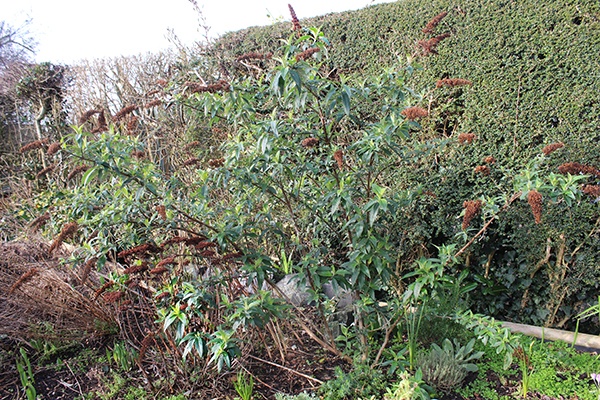
Autumnal Buddleja davidii
1 year of extensive growth

Buddleja (or Buddleia) davidii produces new growth on new wood, and will produce up to 3 metres of growth in 1 year. So, if you don’t cut it back each year you will end up with a very tall plant of old woody stems with straggly new growth on top.

Cut it back hard – now!

You can’t really over-prune it. It needs cutting back hard to about 1 foot from the ground in early Spring (now) – provided the weather is mild – before it starts producing new growth.

1. Trim back top growth with secateurs. This will make it easier to get to the lower stems near the base of the plant.

Pruned branch of Buddleja davidii
Prune back top stems of Buddleja davidii with secateurs

2. Cut back the thick woody stems near the bottom to 1–2 feet (30–60 cm) above the ground. You will probably need a pruning saw or lopper for this, as the stems will be pretty thick near the base of the plant.

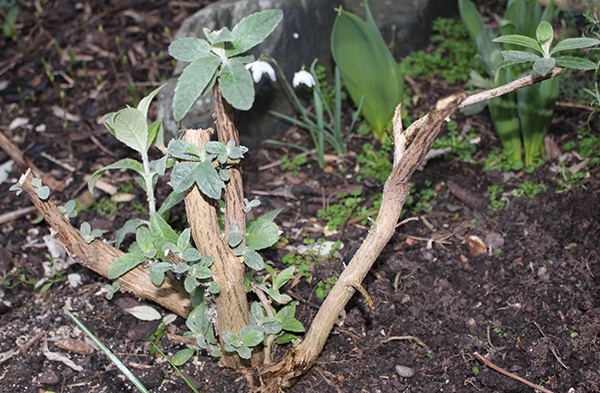
Pruned Buddleja davidii
Cut back the woody stems near the base to about 1 foot from the ground

Try to keep an open framework of 5–6 main branches. Remove any crossing branches that will rub on other stems. The Buddleja in the photo above is only a couple of years old, so there aren’t too many stems yet, but the older it gets the more stems it will produce.

If your Buddleja is very congested around the base with old dead stems, remove them completely (either to the ground or cut them off flush to the stem).

Be brave, be brutal

It seems severe, but don’t be alarmed by the way your Buddleja looks. I promise it will regrow … a lot! In fact, you’ll be amazed how quickly it starts to produce new growth.

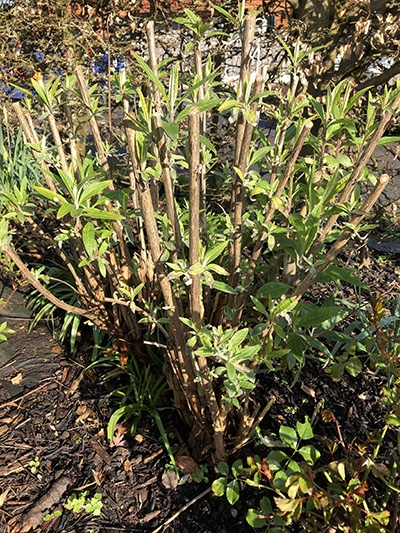
Buddleja fast regrowth
This Buddleja is about 6 years old and was chopped back in November last year. It’s already full of regrowth. I now know to reduce the number of stems next year and prune in early Spring (always learning!)

Prune the right Buddleja in the right way

One important note here. Make sure you are pruning Buddleja davidii in this way, and not Buddleja alternifolia or Buddleja globosa. Both of these Buddleja species produce new growth on old stems, so they should never be cut back hard in the way described above.

End-of-winter arrangement

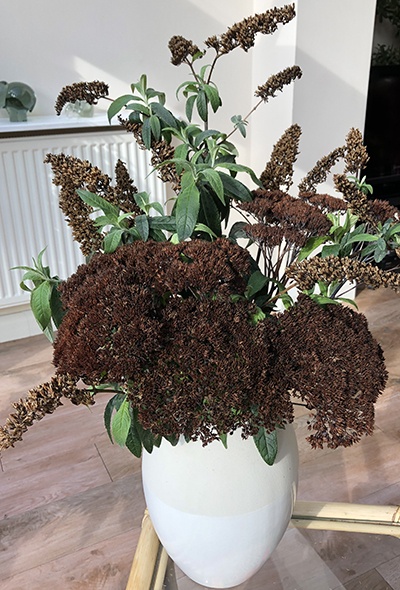
I thought the upper stems were pretty, so instead of throwing them all away I created an end-of-winter flower arrangement. Combined with the winter stems of Sedum spectabile, it turned out to be quite striking.

Winter flower arrangement of Buddleja and Sedum
A striking arrangement using winter stems: Buddleja davidii and Sedum spectabile

Marching on

The last (extra) day in February this year brought with it more rain, more wind and even some sleet. But I managed to dodge the showers and get out long enough to finally prune my Braeburn apple tree.

Apple-tree-pruning
Apple tree pruning under stormy skies

I had to be careful not to stand on the lawn or soil for too long, as the ground was absolutely saturated. A couple of wooden boards helped me to avoid turning the area into a muddy mess.

Stay_off_the_grass
By laying wooden boards on the wet ground I didn’t compact the soil too much

What a difference a day makes

I said goodbye to February with a tinge of relief, and welcomed in March with a heavy dose of optimism. I was rewarded with a day of blue skies and sunshine, and chased the sun around the garden, pruning and weeding and planning for the gardening year ahead.

1st-of-March-sunshine
Pots and borders bathed in spring sunshine

#15greenmins in March

And so the frenzy of weeding, sowing and planting begins. I confess, as the working week starts again, the thought of all those jobs is a tiny bit overwhelming. But then I remind myself – you can do anything for 15 minutes.

Take a look at my #15greenmins March checklist and hopefully all those March tasks won’t seem quite so daunting. Keep Marching on!