English vs Spanish bluebells

If you have been walking in the woods over the past few weeks, chances are you have come across a quintessentially British sight: deep violet-blue carpets of English (or common) bluebells. Blooming in April and May, they are the last of the Spring flowers to emerge from the woodland floor before the leaf canopy thickens overhead and blocks out the sunlight.

Although native to Western Europe, half of the world’s common bluebells can be found in the UK, where they are a protected species. Most grow in, and on the edges of, ancient broadleaf woodlands, but they also grow in hedgerows and grassland and even on coastal clifftops.

Bluebells on the Cornish coast
Bluebells on the Cornish coast near Port Isaac

A Spanish rival

Unfortunately, the English bluebell (Hyacinthoides non-scripta) is under threat from the invasive Spanish bluebell (Hyacinthoides hispanica). The Victorians introduced the Spanish bluebell as a garden plant, but in the early 1900s it escaped beyond the garden fence. Let loose in the countryside, it has been found to outcompete and cross-pollinate with our native species to produce vigorous hybrids, particularly in urban areas.

How to tell the difference?

It is fairly easy to spot the difference between Spanish and English bluebells.

English vs Spanish bluebells, how to tell the difference
Spot the difference. (Left) English bluebell. (Right) Spanish bluebell.
EnglishSpanish
Flower colourDeep violet-blue (occasionally white)Pale blue; also pink and white
Flower shapeNarrow, tubular bells with tips that curl backOpen, conical bell, with open, spreading tips
StemsArching with flowers on one sideUpright with flowers on both sides
PollenCream-colouredBlue- or pale green-coloured
LeavesNarrow, ~1.5 cm wideBroad, ~3 cm wide
ScentSweet scentLittle or no scent
Cream-coloured pollen of English bluebell

Be plant wise

Although Spanish bluebells are very pretty and easy to grow, be aware that they are likely to outgrow their welcome in your garden. They multiply rapidly and are very deep-rooted, which makes them incredibly difficult to eradicate once established.

A few bulbs in my garden (which, to be honest, I don’t remember planting, so may have seeded in my garden from elsewhere) rapidly spread within 3–4 years throughout one of my herbaceous borders. They were lovely to look at and were a big hit with the bees, but they were complete thugs, forming dense clumps that started to smother smaller plants in the border.

So, I recently spent several hours trying to dig them all out. I found all sizes of bulbs at varying depths, and I definitely didn’t manage to remove them all. I’m sure I’ll be digging them out for several years to come.

Bluebell bulbs
Spanish bluebell bulbs of varying sizes

Tips for gardeners

  • Ideally, plant native English bluebells rather than Spanish bluebells. They grow best in free-draining soil in partial shade.
  • Buy English bluebell bulbs from reputable sources to ensure they have not been sourced from the wild.
  • Don’t plant Spanish bluebells if you live near woodland where English bluebells are growing.
  • Cut off seed heads of Spanish bluebells after flowering to stop the windborne spread of seeds outside the garden.
  • Dispose of Spanish bluebell bulbs responsibly in council garden waste collections so they don’t end up somewhere they shouldn’t be.
Bluebell seed heads
Cut off the seed heads of Spanish bluebells to prevent them spreading

Tips for walkers

  • Be aware of the law. English bluebells are a protected species, which means it is illegal to pick, uproot or damage them.
  • Stick to designated paths through woods and avoid trampling bluebells. They can take years to recover from damaging footfall.

Where to see bluebells

Both the National Trust and Woodland Trust have lots of information on where to see bluebells. If you have any recommendations for bluebell walks let me know.

A carpet of bluebells, in Strid Wood, Bolton Abbey
A carpet of bluebells in Strid Wood, Bolton Abbey, Yorkshire

Potatoes: a whole new language

A lot of gardeners have Easter marked as the time to start planting their potatoes. I guess it’s the prospect of a long weekend in the garden or on the allotment that turns our thoughts to planting spuds.

But before you start digging, do you know your ‘first earlies’ from your ‘maincrops’? Have you heard of ‘indeterminates’ and ‘determinates’? What are ‘seed potatoes’ and do you need to ‘chit’ them? Yes, the humble potato (Solanum tuberosum) comes with a language all of its own.

Freshly harvested potatoes

Seed potatoes

Seed potatoes are potatoes from last year’s harvest that you grow this year’s potatoes from. It’s fine to use a few tubers from your previous crop if they have stored well over winter and look healthy. However, using potatoes from your own crops year after year runs the risk of carrying over any disease that might be present. With that in mind, it is also important not to grow potatoes in the same soil each year, as pests and diseases are likely to build up.

In general, it’s best to use a fresh stock of seed potatoes from a garden centre or online catalogue. They will be virus free and guaranteed to give you a tasty, disease-free crop. There will also be plenty of varieties to choose from.

Potatoes chitting on a window sill
Seed potatoes guaranteed to be virus free

Although it is possible to grow potatoes from store-bought eating potatoes, you won’t get the same disease-free guarantee. If you decide to try this, make sure you buy organic as some eating potatoes are treated with a chemical that prevents sprouting.

First earlies, second earlies and maincrop potatoes

These terms simply relate to the time when you plant and harvest your potatoes. First and second earlies (new potatoes) are often planted at the same time, with second earlies being ready for harvesting a few weeks later than first earlies. Maincrop potatoes are generally planted a bit later, take longer to grow and are harvested later in the year.

When to plant potatoes

There is no hard and fast rule for when you should plant potatoes. It will depend on the temperatures in your region. Later planting (up to a couple of weeks before your last frosts) simply means later harvests, so don’t panic if you can’t start planting over the Easter weekend! As a very general guide…

First earlies can be planted around the end of March/early April for harvesting 10–12 weeks later in June/July. They are the earliest to crop, hence the name ‘first early’. Popular varieties of first early potatoes include:

  • Arran Pilot
  • Duke of York
  • Foremost
  • Orla
  • Pentland Javelin
  • Rocket
  • Sharpes Express
  • Swift

Second earlies can be planted in mid-April for harvests 14–16 weeks later from July onwards. Popular varieties of second early potatoes include:

  • Charlotte
  • Estima
  • Jazzy
  • Kestrel
  • Maris Peer
  • Ratte

Both first and second earlies tend to be small and flavoursome new potatoes, ideal for boiling and steaming. They are best eaten soon after harvest.

Main crop potatoes can be planted in mid- to late-April for harvesting after 15–20 weeks from late August onwards. Popular main crop varieties include:

  • Cara
  • Desiree
  • King Edward
  • Maris Piper
  • Navan
  • Pink Fir Apple

Maincrop potatoes tend to be bigger than first and second earlies and can be baked, roasted or fried. They also store well over winter.

Chitting

Chitting is the process of forcing seed potatoes to start sprouting a few weeks before they are planted out (see How to chit potatoes). Left in a cool dry place in the light, the ‘eyes’ of seed potatoes produce stubby sprouts called ‘stolons’. When planted below ground, the stolons grow upwards to create the new potato plant.

Chitted potatoes, ready to plant
Chitted and ready to plant

Chitting is a good way of getting early varieties off to a head start so that they get growing quickly when they are planted, but it isn’t essential.

Indeterminate versus determinate potatoes

I only discovered these terms a few weeks ago and they will completely change the way I grow my potatoes this year, as indeterminate and determinate potatoes have different growth habits.

Indeterminate potatoes produce their crop at intervals along the growing stem in multiple layers. As the plant grows up you need to keep covering the stem (‘earthing up’) so that the layers of potatoes remain underground. You need vertical space for this type of potato and they take longer to grow than determinate varieties. Most (but not all) maincrop potatoes are indeterminate.

Determinate potatoes grow in a single layer just below the seed potato in the top layer of soil. They will benefit from a layer of mulch as they grow to ensure any tubers that break through the surface are protected from the light. The plants do not grow very tall and flower earlier than indeterminate varieties. Most (but not all) early varieties are determinate.

Growing potatoes in containers

With limited veg-growing space, I’ve always grown my potatoes in sacks. For years I’ve been planting 2 or 3 potatoes deep in each sack and ‘earthing up’ around the stems as they grow, thinking that they are growing layers of potatoes. But it turns out that most of the varieties I’ve been growing are ‘determinate’ and have therefore been growing in a single layer. So, this year, I will still plant them in sacks, but I will plant 2 seed potatoes in the bottom third of the sack, then another 2 in the next third. In theory, I should get double the harvest in the same space. Result!

Potato sacks in leaf
Sacks of potatoes

Whatever type or variety of potato you decide to grow, and whether you chit or not, there is nothing more satisfying than harvesting flavoursome home-grown potatoes.

Homegrown Charlotte potatoes

So let me know what you’re growing this year and any potato-growing tips you want to share.

How to choose the right Mahonia

Mahonias are fantastic evergreen plants, with clusters or spikes (racemes) of scented yellow flowers that are rich in nectar and a magnet for foraging bees in winter. The different species of Mahonia come in a range of sizes to suit any garden type, and flower at different times from late autumn to early spring.

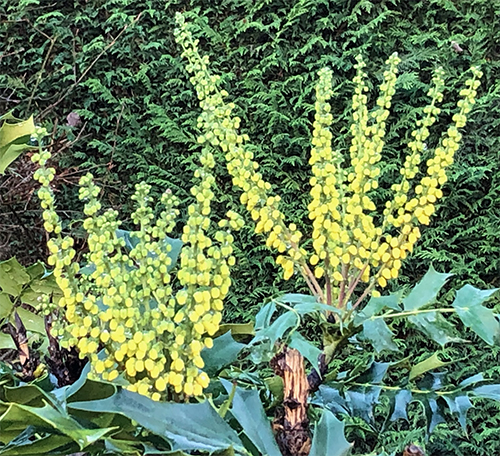
Mahonia in bud: a rich supply of nectar through the winter months
Mahonia in flower: a rich supply of nectar in December in my garden

Mahonia or Berberis?

Mahonias are members of the Barberry family (Berberidacae). However, botanists haven’t completely agreed on the nomenclature. Don’t be confused (as I was) if you see the same plant with two different names: Berberis and Mahonia. Mahonia aquifolium is also sometimes known by its common name of Oregon grape (Oregon adopted it as its official state flower in 1899) .

Best features of Mahonia

Mahonias tend to be planted for their bold architectural foliage. Most Mahonias are large shrubs with rows of glossy, deep green, spine-toothed leaves. However, there is a variety called Mahonia eurybracteata ‘Soft Caress’ that has spine-free foliage if you are looking for something softer.

The biggest delight is the characteristic clusters of scented yellow flowers. These are followed by pretty purply-blue berries.

Mahonias tolerate all types of well-drained soil, and will thrive in sun or shade. This makes them a good choice for ‘problem’ areas of the garden. Most are fully hardy, down to –15oC.

Mahonia berries

Key factors when choosing a Mahonia

To find the right Mahonia for your garden it is worth considering both size and flowering time. Although there are about 70 species of Mahonia, a few key varieties tend to be sold by garden centres or online retailers in the UK.

Mahonia x media ‘Winter Sun’, ‘Charity’ and ‘Lionel Fortescue’ can grow to 2.5–4 metres in height, although they can taken 10–20 years to reach their ultimate size. Being large upright shrubs, these varieties are ideal as a focal point at the back of a border. Sometimes they are used as hedging. They tend to flower between late November and early January.

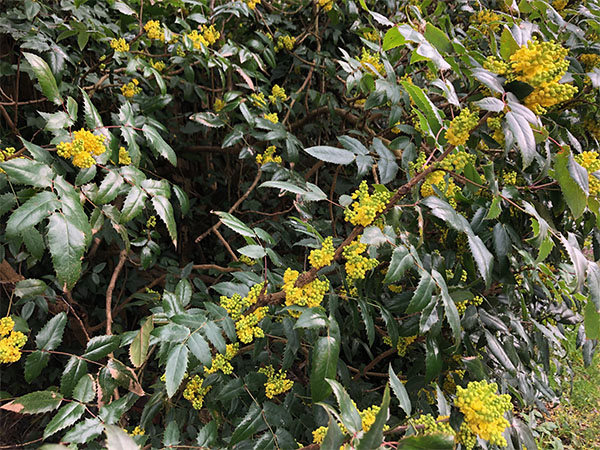
Mahonia japonica is smaller than the ‘Media’ varieties, but is another erect shrub that can grow to 1.5–2 metres in height. It also flowers between the end of November and March.

Mahonia japonica in a border of mixed shrubs at the bottom of my garden

Mahonia aquifolium ‘Apollo’ is a more compact variety that grows in a low spreading dome. It reaches about 1 metre in height and spreads to about 1.5 metres.

Mahonia aquifolium 'Apollo' shrub
Mahonia aquifolium ‘Apollo’

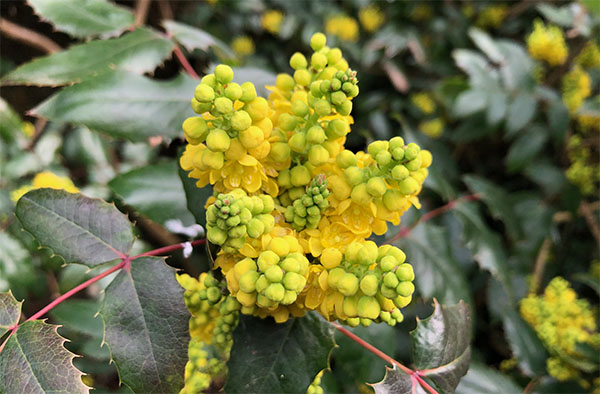
I pass this one on my daily dog walk. It has been bursting with compact clusters of intensely scented flowers all through February. It is thriving in a sheltered walkway next to a fence where it gets both sun and shade.

Highly scented flowers of Mahonia aquifolium 'Apollo'
Intensely scented flowers of Mahonia aquifolium ‘Apollo’

Mahonia repens has a low, creeping habit, with a height of 30–50cm and spread of 1 metre. It is ideal for shady ground cover, at the front of a border, or to cover a bank. This variety flowers in mid to late Spring (April/May).

Planting Mahonia

March is a good time to plant Mahonias. Make sure you choose a spot where your variety of choice has enough room to grow. I initially planted my Mahonia japonica too close to a conifer hedge and had to move it (see Mahonia on the Move). Dig a hole that is twice the size of the root ball. Plant the Mahonia with some well-rotted compost and firm it in well before giving it a good soak.

Mahonia care

Mahonias are low maintenance plants. They have low nutrient requirements, but like most shrubs will appreciate a mulch in early spring and/or autumn. This will also help to suppress weeds around the base. They can tolerate relatively dry conditions, so they only need watering in times of drought.

Pruning. Thankfully, pruning can be kept to a minimum, not least because the holly-like leaves can make it an uncomfortable process. In fact, you don’t need to prune a Mahonia at all unless your shrub loses its shape or gets too leggy.

If you do need to prune, make sure you are wearing a sturdy pair of gardening gloves. After flowering, remove any dead or diseased branches, or any branches that are growing out at an awkward angle or crossing with other branches.

If your Mahonia has become bare at the base, you can give it a hard prune by cutting a third of the branches down to about 15 cm (6 inches) from ground level. It will look a bit sorry for itself for a while, but this will help to generate fresh growth from the base.

To make plants bushier, cut back branches by 30–50%, which will stimulate the production of side shoots.

Avoiding disease. In general, Mahonias remain pest and disease free. Powdery mildew and rust are potential problems though. To help avoid these, make sure you water at the base of the plant and not on the leaves, regularly remove dead leaves and material from around the plant, and prune out a few central branches to let air circulate through the plant. Remove any affected leaves as soon as the problem appears so that it does not spread to the rest of the plant.

Go get a Mahonia

In summary, a Mahonia will add winter colour and nectar to your garden, will grow pretty much anywhere, and will be relatively low maintenance. So, if you have the room, I highly recommend you go out and get a Mahonia.

Love letter to my garden

Happy Valentine’s Day, Dear Garden,

I woke up this morning feeling a little down. It was raining (again) and the world outside seemed very grey, both in colour and spirit. I came downstairs to make a cup of tea and gazed through the rain-splattered windows.

More rain…

And there you were, as always, waiting for me. No judgement, no agenda. Always changing, yet ever familiar. Ready to put a smile on my face.

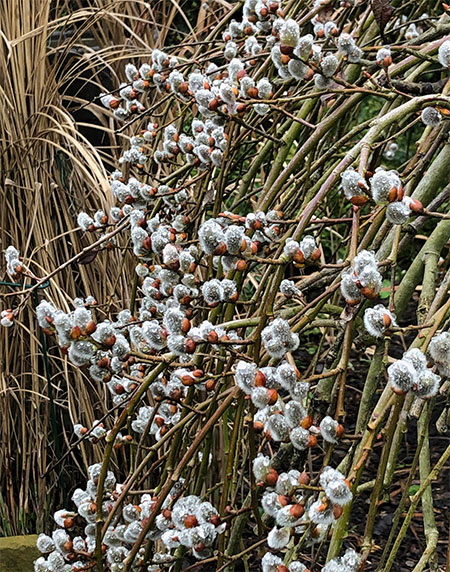
Even on this murkiest of murky days, I see borders dotted with vibrant green shoots, a willow tree smothered in fluffy silver catkins…

Raindrop-bejewelled willow catkins

…clumps of pure white snowdrop brilliance, and the gently nodding pastel heads of self-seeded Hellebores.

Christmas roses trump red roses today

I’m sorry I’ve neglected you these past few months. You’ve been too frozen or too soggy for me to apply any meaningful care, and now you eagerly await the removal of winter’s debris and carpets of perennial weeds.

Soon, my love. Very soon. I promise!

You have put up with so much: the pruning that I get wrong, the staking that I forget to do, and of course the impulse buys that move around your borders until they find the perfect home.

You have given so much: an ever-changing tapestry of colour and form…

A constantly changing tableau

…a home to countless creatures (with new surprise residents every year)…

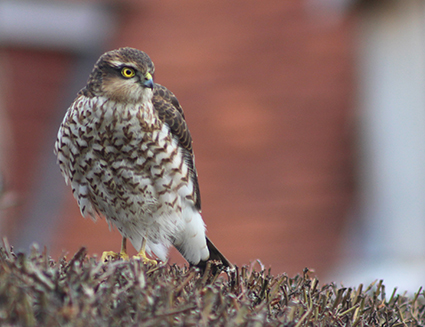
Female sparrowhawk
Female sparrowhawk

…the delight of tasty home-grown produce (even at the end of winter, you have leeks and beetroots to offer for the pot)…

Bedraggled but tasty leeks and beetroot

…sweet exotic scents on warm summer evenings, and the sparkling artistry of frozen cobwebs and frosted seed heads in winter.

A frosty cobweb

You have taught me so much too. Not just newfound practical skills, but the importance of planning, greater appreciation of the changing seasons, and a better understanding of the life that flits above your canopies and crawls within your hidden spaces.

You have helped me with the things I find most difficult. How to focus on one thing at a time, to let go of perfectionism and live in the moment…

The garden will never be perfect – but that’s OK!

…and to be more patient. All still a work in progress, but you are a tolerant and forgiving teacher.

So, thank you, dear friend for helping me find an inner calm… for keeping me healthy…for getting me just a little bit dirty every now and then…for getting me outside in the fresh air, away from my desk…for encouraging me to be creative…for reminding me of the wonders of Creation…and for bringing me so much joy.

You are, and always will be, my happy place!

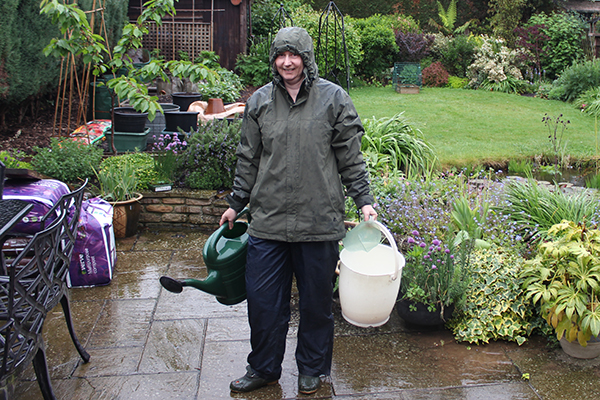
Gardening-in-rain
Out in my happy place, whatever the weather

With love, always xx