3 Plants to Cut Right Down Right Now

Some garden jobs have an early Spring deadline on them. Hard pruning certain plants is one of them. If, like me, you are a reluctant pruner – beware! This can be a traumatic process.

As we head into April (how did that happen?!), don’t delay in giving the 3 plants featured below the big chop as soon as possible.

Shrubby Cornus (dogwood)

Mid-March to mid-April is the perfect time to hard prune shrubby dogwoods, ideally before they start bursting into leaf. These plants are usually cultivated for their colourful winter stems. They are not to be confused with flowering dogwoods, which are usually trees. Common types of shrubby dogwood include:

  • Cornus alba ‘Sibirica’, which has vivid red stems
  • Cornus sanguinea ‘Midwinter Fire’, which has flame-orange stems
  • Cornus sericea ‘Flaviramea’, which has distinctive yellow-green stems

I’ve had the ‘Midwinter Fire’ variety in a pot for several years. It was spectacular over the winter, but the intensity of colour started to fade in March.

Cornus sanguinea 'Midwinter Fire'
Cornus sanguinea ‘Midwinter Fire’

I’ve left it alone up to now, but I figured it was time to be brave and go for the chop. I cut the stems down to about 2 inches from the base above a leaf node.
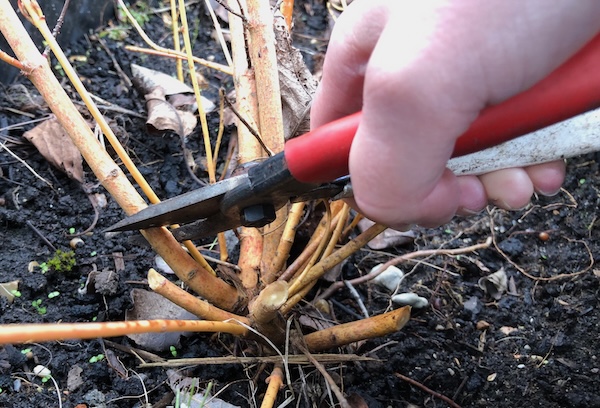
Cut Cornus near the base to encourage new colourful stems

It looks brutal and I will probably lose sleep over it until new stems start to grow.
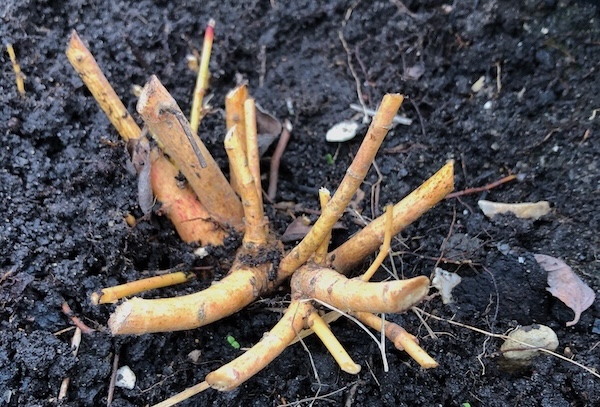
Pruned Cornus
Pruned Cornus

I’ll also be moving this particular Cornus out of its pot into a sunny border spot. The stems are more vibrant if grown in full sun.

One added bonus of tidying up this plant was an offshoot with a decent root system. I separated it from the plant and potted it up, so I should get a second dogwood for free. Perhaps I will eventually have a matching pair standing on guard on either side of the pond.
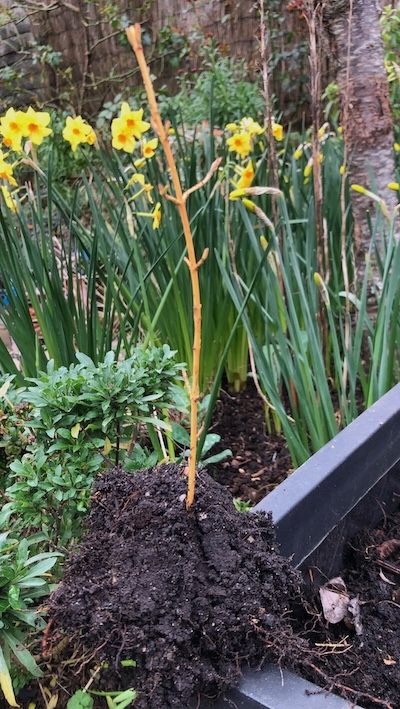
Extra Cornus for free

I also kept the cuttings and used them as supports for my jonquils (Narcissa jonquila). They were getting battered in the wind but the dogwood stakes kept them upright.
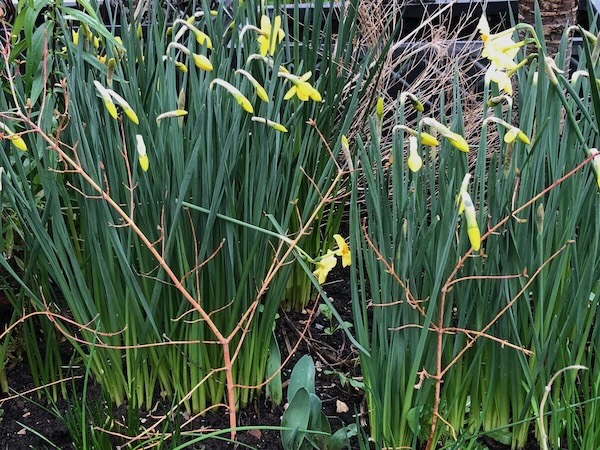
Pliable Cornus cuttings make great stakes for other plants

Meanwhile, I haven’t pruned the Cornus alba ‘Sibirica’ hedging that I put in last Spring. I want that to thicken up and get more established first.
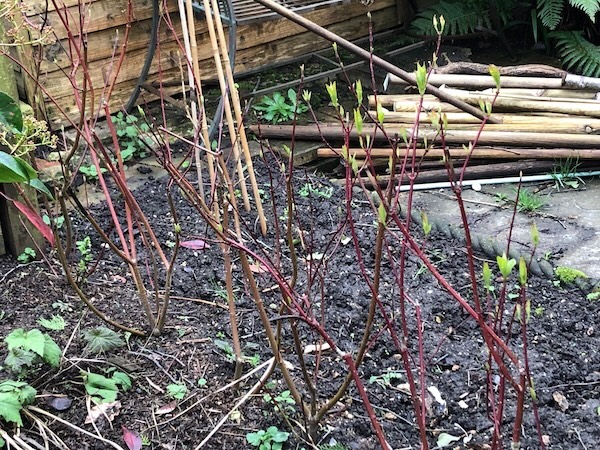
Young Cornus alba 'Sibirica' (red stemmed) hedging
Young Cornus alba ‘Sibirica’ (red stemmed) hedging

Buddleja davidii (standard Buddleja)

Standard Buddlejas (or Buddleias) should also be cut right down at this time of year to encourage new bushy growth. Chop them to abut 30cm (1 foot) above ground. Otherwise, they get leggy with just a few blooms at the top of the plant.

My husband had already cut our Buddlejas in November to about half their summer height. He loves hacking plants down!

Partially pruned Buddleia

This partial reduction in height reduces the plant’s wind resistance and prevents ‘root rock’ over the winter months. Buddlejas can get very tall and as such get battered by high winds. This loosens the roots and weakens the plant.

But now is the time for the big chop. Cut at an angle just above the first or second growing shoot from the base. Use sharp loppers or a pruning saw for thicker stems. Remove any dead stems. You’ll be left with a woody clump but don’t panic – it will grow back!
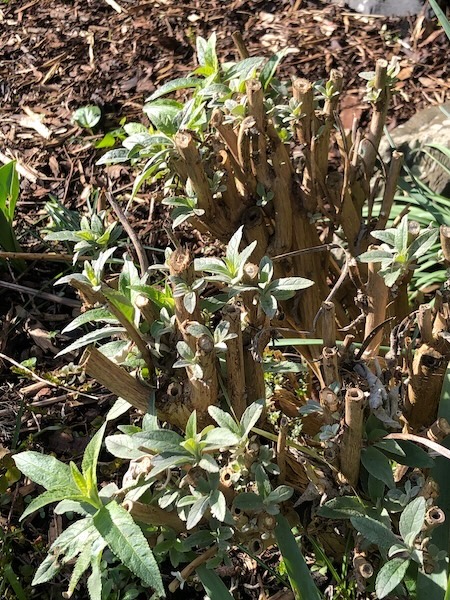
Cut Buddleja to about 1 foot off the ground

For more information see Pruning Buddleja davidii

It’s brutal but essential for the health of the plant. You’ll get bigger better blooms that visiting butterflies will thank you for.

Peacock butterfly on Buddleja pannicle

Important note: Buddleja alternifolia and Buddleja globosa flower on last year’s growth, so don’t chop these plants in the same way.

Deciduous ornamental grasses

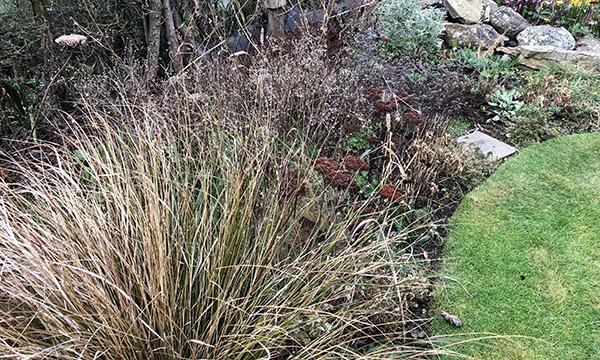
Finally, now is the time to cut back any deciduous ornamental grasses – the ones that have turned completely brown. They give the garden great structural interest through winter, but now this year’s shoots need room to grow.

I have one patch of Zebra grass (Miscanthus sinensis ‘Zebrinus’). It forms a majestic clump of plumed seed heads next to the shed.
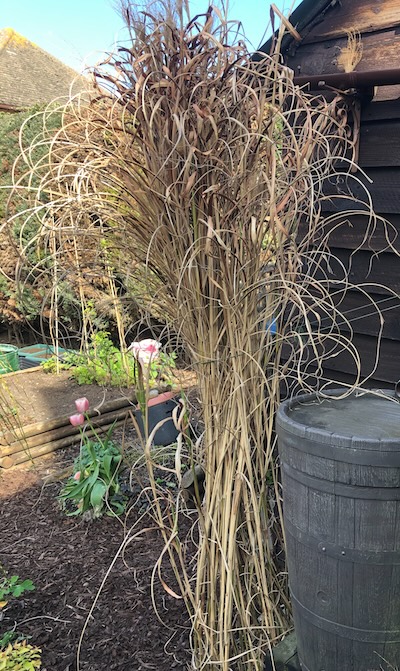
Zebra grass
Over-wintered Zebra grass

Every year I cut the old growth right back to the base with sharp secateurs, avoiding the green shoots that are starting to emerge. One top tip: wear long-sleeved clothing as the grass can be very sharp and and/or scratchy. I shred the old stems and add them to the compost.
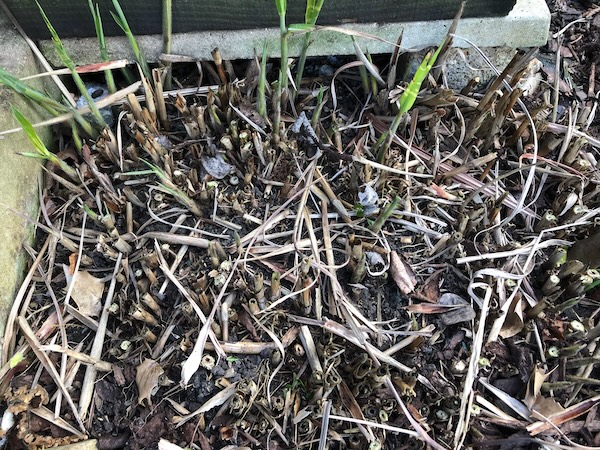
After the hack
After the hack

If you don’t cut these grasses down soon, new shoots will struggle to get through. The longer you leave it the harder it will be to cut out the old stems without affecting the new growth.

So don’t delay – chop chop!
How to divide and manage pheasant’s-tail ornamental grass

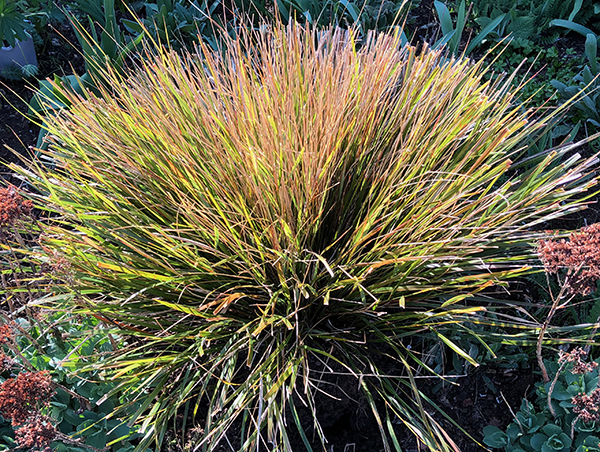
I don’t have many grasses in my garden, but a couple of years ago I acquired a small pot of, what I call, pheasant grass (Anemanthele lessoniana, syn. Stipa arundinacea), which had seeded itself in a friend’s garden. Its most common names are pheasant’s-tail grass and New Zealand wind grass. It’s a lovely ornamental grass that provides a spray of year-round colour in various hues of copper, bronze, russet and gold. It starts off as quite a loose arching spray, but (as I found out!) can form a dense clump as it matures.

Dense clump of Pheasant grass
Dense clump of pheasant grass (trimmed)

Everything I read said that it was an ideal grass for adding colour, movement and structure to a border and that it would self-seed itself (as it had done in my friend’s garden), so I popped it in my newly enlarged herbaceous border that runs down the side of the garden.

All was well for a while. Pheasant grass will thrive in any well-drained soil, in a sheltered or exposed spot. It prefers plenty of light but will do okay in partial shade as well. It was certainly happy in my sunny clay-based border, so much so that by the end of last year, 3 years after planting it, it had outgrown its welcome, swamping everything else around it.

Oversized pheasant's-tail grass
My small spray of pretty pheasant’s-tail grass had become an oversized monster

Pruning evergreen ornamental grasses

My first plan was to try tidying it up. As a grass-growing newbie, I read up on it and found that, unlike the pruning of deciduous ornamental grasses, you should never cut an evergreen ornamental grass down to the ground, as it is unlikely to recover. You need to be a bit more selective and pull out the dead stuff.

In the utopian world of expert gardeners, you can ‘run your fingers through the grass and pull out the dead bits’. I tried this briefly and nearly lost my fingertips. Ouch! Apparently, only do this with young grasses that have been well maintained with a light pruning every Spring. If you’re not sure, wear gloves, as some grasses can be razor sharp! I have the scars to prove it.

The individual strands of my congested clump of pheasant grass were thick and tough, and they didn’t come away from the base of the plant when pulled. Instead, I had to selectively prune as many of the dead strands out as I could by cutting them individually from the base with secateurs. Not easy!

I then gave the whole clump a light trim to put some shape back into it (see top photo).

Dividing evergreen ornamental grasses

It was still too big for the border, so I decided to lift and divide it. It took a fair bit of digging out, and I certainly couldn’t ‘tease it apart with back-to-back forks’, as advised by the experts. Brute force, a sharp-edged spade and a lot of swearing worked though, and I eventually managed to split it into four much more manageable clumps.

Dividing a large clump of Pheasant's-tail grass
Divide and conquer: one clump becomes four

A new home

I decided a prairie-style border wasn’t for me (I’m more of a cottage garden kind of girl), so I have made room for a much more manageable lupin (which the slugs will probably eat), and rehomed the new clumps of pheasant grass at the back of a border in the front garden. It will be interesting to see how they fair. I fear it might be too late, as the grass has become very congested, but I’m giving it a chance.

Rehomed clumps of pheasant's tail grass
Rehomed clumps of pheasant’s-tail grass

Lessons learned

I now know that you need to do a little light pruning of perennial evergreen grasses every Spring, pulling out the dead strands. If they self-seed, you can replace older plants with the seedlings. Tougher clumps (like mine) can be sawn apart if necessary. In theory, division should reinvigorate the plant. We’ll see!